
Prepayments and credits
A prepayment (or credit) is money that a client has paid you, or that you have paid a supplier, which isn’t linked to an invoice yet. QuickFile holds it on the client’s or supplier’s account until you use it to pay down an invoice, or refund it.
Typical examples are deposits, payments made in advance of an invoice, and overpayments. In this guide we’ll use a client credit as the example. The same principle applies to supplier credits.
Adding a prepayment manually
-
Open the client record, either from Sales > View clients or by using the quick search on the Dashboard.
-
Click More Options and select New Prepayment.

-
In the Enter a prepayment (Assign to an invoice later) window, complete the following:

- Amount - the amount received, including any VAT.
- Paid To - the bank account the money was paid into.
- Make credit available for - the currency of the invoices this credit can be used against (for example GBP Invoices). This option lets you hold credits in different currencies.
- Date - the date the money was received.
- VAT Rate - QuickFile calculates the VAT Total for you. For example, a £60.00 prepayment at 20% shows a VAT Total of £10.00.
-
Click Save. You’ll see the message “A prepayment of GBP 60 has been attributed to this client.” The credit now appears in the Prepayments column of the Account Balance at a Glance panel on the client record.

Important: Saving a manual prepayment also creates a tagged bank entry (for example “Payment from Greenfield Supplies”) in the Paid To account. If the money already appears on your bank feed or imported statement, don’t use New Prepayment - tag that bank transaction instead (see below), otherwise the receipt will be recorded twice.
Adding a prepayment from a bank transaction
If the money is already on your bank statement, you can assign it to a client’s account using bank tagging.
-
In the bank account, click the red Tag Me button next to the transaction and select Payment from a customer.

-
QuickFile looks for unpaid invoices that match the amount. If there’s no suitable invoice, click Pay down multiple invoices or assign to a client account.
-
In Allocate to Client, start typing the client’s name and select them from the list.
-
If the client has unpaid invoices, they’re listed under Select the invoices you’d like to pay down. To hold the money as a credit instead, tick Payment on account (Assign later).

-
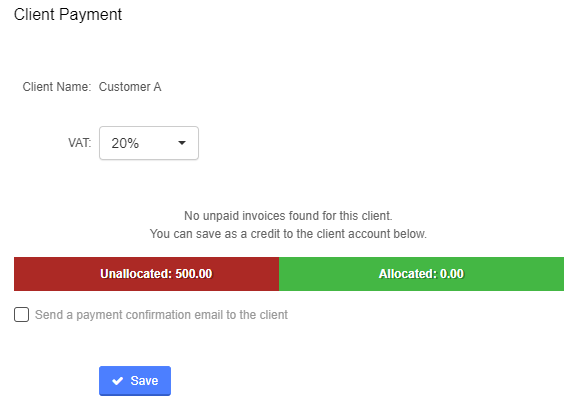
If the client has no unpaid invoices, you’ll see “No unpaid invoices found for this client. You can save as a credit to the client account below.”
-
Check the VAT rate is correct (where applicable) and click Save. You’ll see “Transactions Reconciled - A new credit has been allocated to your nominated client account.”
Tip: When you tick Payment on account (Assign later) you can also tick Create a rule to process matching transactions in the same way, so future transactions with the same reference are handled automatically.
Assigning the credit to an invoice
The credit stays on the client’s account until you use it to pay down an invoice.
-
Open the invoice and click Log Payment.
-
Any available credit is shown in the yellow bar as Apply from credit [GBP …]. Tick the box.

-
If the credit doesn’t cover the full balance, you can leave Amount blank to apply just the credit, or enter an additional amount received and choose the bank account in Paid to.
-
Click Save. If the credit only covers part of the invoice, you’ll see that the invoice is now partially paid.

Refunding a credit
If you need to return a credit to the client (for example, an overpayment), refund it from the payment itself.
-
Open the client record and click View.. then All Payments.
-
Find the payment with an unallocated balance and click View Details.
-
Click Refund balance.

-
Enter the Refund Amount (this defaults to the full unallocated balance), the Refund Method, the Refund Date and the bank account in Refund From.

-
Click Save. The refund is listed against the payment as “Credit refunded to client” and the remaining unallocated balance is updated. A tagged bank entry for the refund is created in the bank account you selected.

Important: Because Refund balance creates the bank entry for you, don’t also tag the refund on your bank feed. If the refund appears there as an untagged transaction, delete that untagged entry to avoid a duplicate.
Finding where a credit came from
If a credit appears when you log a payment and you’re not sure where it came from:
-
Open the client or supplier record and click View.. then All Payments.

-
Unallocated payments show “This payment is currently unallocated” in the Details column. To list only these, click Search, set Type to Unallocated and click Submit Search.
Seeing which clients hold a credit
-
Go to Sales > View clients and click Search.
-
Under Display Columns, tick Prepayments and click Submit Search.

-
A Prepayments column is added to the client list, showing any credit held for each client.
Supplier prepayments
Supplier prepayments work in the same way. Open the supplier record and use More Options > New Prepayment, then use the credit when you log a payment against a purchase invoice.
Prepayments and VAT
Please note: As explained in Adding a prepayment, VAT is levied on client and supplier prepayments, and any unallocated credits are included on your VAT returns. Make sure the VAT rate on the prepayment is correct.
Troubleshooting
A refund of an overpayment can’t be tagged on the bank feed
Bank tagging can’t be used to record the refund of a credit. Use Refund balance on the payment instead (see Refunding a credit above), then delete the matching untagged transaction from the bank feed so it isn’t counted twice.
A credit covers more than one invoice
Open each invoice in turn, click Log Payment and tick Apply from credit to use the credit against it. Repeat for the next invoice while credit remains.
Related topics
- Tagging your bank transactions
- Adding a prepayment
- Managing credit notes
- Refund client overpayment (community discussion)